
190E Manuelle ou Automatique ? La réponse honnête pour chaque variante
Buy the manual if you can find one: every W201 variant carries a value premium with three pedals, and on a Cosworth the dog-leg Getrag is half the car's character. Buy the automatic for a 190E 2.6 daily driver, where the 722.4 four-speed suits the six's torque and shrugs off neglect better than any clutch.
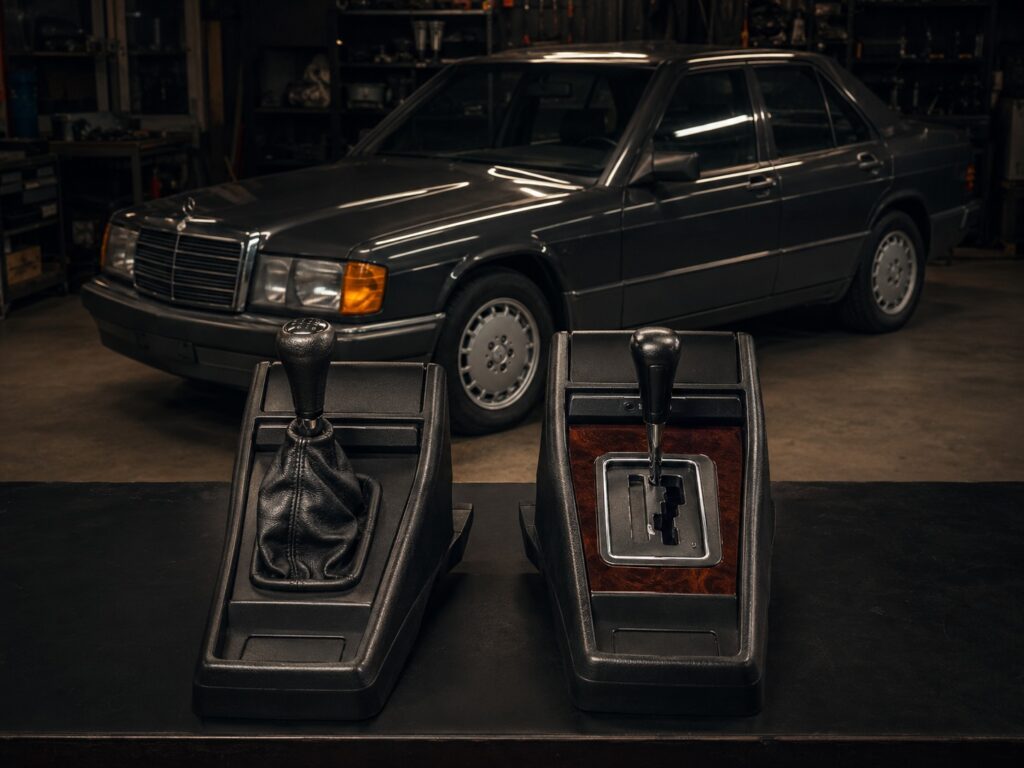
Buy the manual if you can find one: every W201 variant carries a value premium with three pedals, and on a Cosworth the dog-leg Getrag is half the car’s character. Buy the automatic for a 190E 2.6 daily driver, where the 722.4 four-speed suits the six’s torque and shrugs off neglect better than any clutch.
The verdict by variant
| Variante | Verdict | The reason |
|---|---|---|
| 190E 1.8 / 2.0 | Manuel | The small fours need revs; the auto eats what little urgency they have |
| 190E 2.3 | Either | Enough torque to carry the auto; manual still drives better |
| 190E 2.6 | Automatique | The six’s torque suits it, and most were built this way for a reason |
| 190E 2.3-16 / 2.5-16 | Manual, no debate | The dog-leg Getrag is part of the homologation story; autos exist (US cars) and trade at a discount |
| 190D diesels | Manuel | The autos sap power the diesels cannot spare; manual diesels also outsell autos used |
The market agrees with the table. Manual examples of every variant ask and get more money, with the gap widest on the Cosworths, where a US-spec automatic 2.3-16 trades 20 to 30 percent under an equivalent European manual.
Which gearboxes did the W201 offer?
Three families served the whole eleven-year run.
The 722.4 four-speed automatic is the most common box in the range, fitted across petrol fours, the 2.6, and the diesels. It’s a hydraulically controlled Mercedes unit from the era when the company over-built transmissions: fluid coupling, four ratios, second-gear starts in normal mode. Our parts interchange register lists it shared with four-cylinder W124s and early W202s, which keeps the parts supply healthy.
The standard five-speed manual (and the four-speed on early base cars) is a conventional H-pattern Mercedes box. Unremarkable, durable, and the reason manual 2.0s feel quicker than their 122 hp suggests.
The Getrag dog-leg five-speed belongs to the 16-valve cars: first gear left and down, second through fifth in a tight H. Ratios sit close together (4.08 through 1.00 to one, per the référence technique) because the box was specified for circuit work, where you live in second through fifth and first exists for the pit lane.
What is the 722.4 like to live with?
Better than its age suggests. The box starts in second gear by default, which reads as laziness until you learn it’s a comfort calibration: floor the pedal or move the selector and first appears. Kickdown is decisive. Shifts are smooth when the fluid is fresh and the vacuum modulator is healthy.
Living with one costs a 60,000 km fluid-and-filter service (per the calendrier de maintenance) and attention to two known items. A harsh or delayed 2-3 shift usually means the vacuum modulator or its line, a £40 part and an afternoon. Whining in reverse on a high-mileage box means the rebuild conversation, £1,200 to £1,800 exchange, though most boxes never get there. The 722.4’s real enemy is the owner who believed “sealed for life.”
First-gear-start conversion: the selector linkage and a valve-body adjustment can make first-gear starts the default. Most owners drive a week and stop noticing second-gear starts instead.
What is the dog-leg Getrag like to live with?
A week of wrong-slot embarrassment followed by years of preferring it. Second through fifth sit in line, so the gears you swap between on a road never cross the gate. The shift itself is mechanical and deliberate; this is not a Honda box, and hurrying it is how the second-gear synchro earns its reputation.
That synchro is the unit’s one known weakness: a cold crunch into second is endemic on high-mileage cars. It’s a rebuildable wear item, not a death sentence, and a £600 to £900 line in a negotiation. The clutch is the other budget line: an engine-out-adjacent job on the 16v cars, £700 to £1,000 fitted, with a high biting point as the early warning.
Drive one before you pay Cosworth money for either body style of answer. The gearbox decides whether you love these cars.
Which costs more to run?
Across ten years the totals land closer than the internet suggests.
| Cost line | Manuel | 722.4 automatic |
|---|---|---|
| Routine service | Gear oil at 100,000 km, ~£40 | Fluid + filter at 60,000 km, ~£160 to £220 fitted |
| The big wear item | Clutch: £600 – £1,000 fitted | Nothing scheduled; modulator £40 if shifts harshen |
| Worst case | Synchro rebuild £600 – £900 (16v) | Full rebuild £1,200 – £1,800 |
| Carburant | Référence | Roughly 1 to 2 mpg worse |
The automatic is cheaper until the day it isn’t; the manual spreads its cost into predictable wear items. On value alone, the manual’s resale premium repays its clutch fund on every variant.
How to judge each gearbox on a test drive
Fifteen minutes tells you everything either box wants to confess. Take both checklists to a viewing; the guide d'achat covers the rest of the car.
Testing a 722.4 automatic: 1. Check the fluid before driving: warm, idling, in Park. Bright red and odourless passes; brown or burnt-smelling means the £200 service at best and a tired box at worst. 2. From cold, select Reverse and Drive with your foot on the brake. Engagement within a second, without a clunk, is healthy. A long pause before reverse engages is the box’s most honest wear signal. 3. Drive the 2-3 shift at gentle throttle. Harsh or delayed points at the vacuum modulator; smooth means the hydraulics are happy. 4. Force a kickdown at 60 km/h. It should drop a gear without drama and hold it under load. 5. Listen in reverse with the window down. Whine here is the expensive noise.
Testing a manual (standard or Getrag): 1. Clutch biting point: low-to-middle pedal travel passes. High and shuddering means the £700-plus job is due. 2. On the Getrag, try second gear cold, deliberately. A crunch now that disappears warm is the known synchro wear, a negotiation item. A crunch when warm too is a rebuild conversation. 3. Hold third under hard acceleration, then lift sharply. The lever should stay put; a box that jumps out of gear under load has worn detents and a bigger bill. 4. Reverse the car uphill. Difficulty engaging reverse repeatedly is linkage bushing wear, the £15 fix from the registre d'échange. 5. Listen at idle in neutral, clutch up then down. A rattle that disappears with the clutch pressed is release-bearing chatter, common and tolerable; grinding is not.
Nothing on either list requires tools, and every fault has a price you can carry into the negotiation.
Which transmission suits which life?
Match the box to the use, not the forum consensus.
City commuting: the automatic, without apology. The 722.4 was built for exactly this, and the manual’s clutch fund disagrees with traffic. B-road weekends: the manual, and on a 16v specifically the Getrag, which turns ordinary journeys into the reason you bought the car. Long-distance touring: either. The automatic’s relaxed lope and the manual’s taller-feeling fifth both cruise at motorway speeds near 3,000 rpm; cabin noise, not the gearbox, sets the comfort ceiling. Towing or alpine use: manual, for engine braking the automatic’s four ratios can’t match downhill. Investment storage: whatever the car left Bremen with. Originality outranks preference the moment the car becomes an asset, which is the Cosworth comparison’s whole argument.
Can you convert an automatic to manual?
Yes, and on standard cars it’s a known swap: W124 and W201 donor manuals, pedal box, flywheel, propshaft and linkage. Done well it costs £1,500 to £2,500 in parts and labour. The arithmetic only works on cars worth the effort, and a converted car must be sold as a conversion. On a Cosworth, an automatic-to-dog-leg conversion costs more than the price gap between buying the auto and buying a manual car in the first place, so buy the right car instead. The exception is a US KAT-spec 2.3-16 bought cheap as a driver, where owners convert for the experience and accept the originality cost. Our Comparaison Cosworth covers what originality is worth before you cut.
How do you verify a car’s original transmission?
The identification plate settles it. Factory option code 420 on the plate means the car left Bremen as an automatic; its absence on a car wearing a 722.4 means a swap somewhere in the past, and the same logic catches automatic-to-manual conversions sold as factory cars. Run the codes through our data card generator or the plate table in the référence technique, and on a 16v cross-check the gearbox suffix stamped with the engine number, where 10 marks a manual unit and 12 an automatic.
A swapped box is not a scandal on a driver-grade car; thirty-five years swap many things. It becomes one at original-spec prices. The plate check takes thirty seconds and removes the argument before the test drive starts.
The diesel footnote: the 190D pairs with both boxes, and the automatic diesel is the slowest W201 configuration sold, a fact its owners report with something close to pride. The manual diesels are the ones taxi fleets ran to 800,000 km, the spec that built the OM601’s reputation, and the used market prices that history in. An automatic 190D suits exactly one buyer: the person who wants the most unhurried car in Europe and means it.
Early-car footnote: the first base 190s carried a four-speed manual. Period-correct, slightly buzzy at motorway speeds, and worth keeping original on a survivor-grade car; the five-speed swap is documented and reversible for drivers.
Foire aux questions
Are automatic 190Es slower? Slightly. The 722.4 costs a few tenths to 100 km/h and one to two mpg. On the 2.6 the torque hides it; on a 2.0 you feel it.
Is the 722.4 automatic reliable? Yes, when serviced. Sixty-thousand-kilometre fluid changes are the entire secret. Most failures trace to fluid that was never changed.
Why does my automatic start in second gear? By design, for smoothness. Full throttle or the selector gives you first. It is not a fault.
What’s the dog-leg pattern for? Racing. First sits out of the H so second-third and fourth-fifth swaps stay on one plane at speed. The W201 16v inherited the box from its DTM homologation brief.
How much is a clutch on a 190E? £700 to £1,000 fitted on 16v cars, somewhat less on standard models. A high biting point means start saving.
Do manual 190Es sell for more? Yes, across every variant. The gap is small on diesels and base cars, and large on Cosworths.
Crunchy second gear on a Cosworth: walk away? No. Price the synchro rebuild (£600 to £900) into your offer. The guide d'achat treats it as a negotiation item, not a disqualifier.
Which transmission do collectors want? Manual, with the dog-leg specifically on 16v cars. Original automatic Cosworths have a small “rare spec” following, but the market premium still sits with three pedals.
Prends ceci avec toi
Vous avez une 190 ?
Soumettez votre build et nous le mettrons en avant sur nos chaînes YouTube, TikTok et Instagram.
Démarrez votre garage →