
Le relais OVP et tous les autres problèmes électriques de la W201, expliqués
A 190E with rough idle, random stalling, or a glowing ABS light usually needs one £50 part: the OVP (overvoltage protection) relay, found beside the fuse box with a fuse on top. After that, the W201's electrical faults rank in a short, predictable list: ground straps, the fuel pump relay, vacuum leaks misdiagnosed as electrical, and the ignition switch.
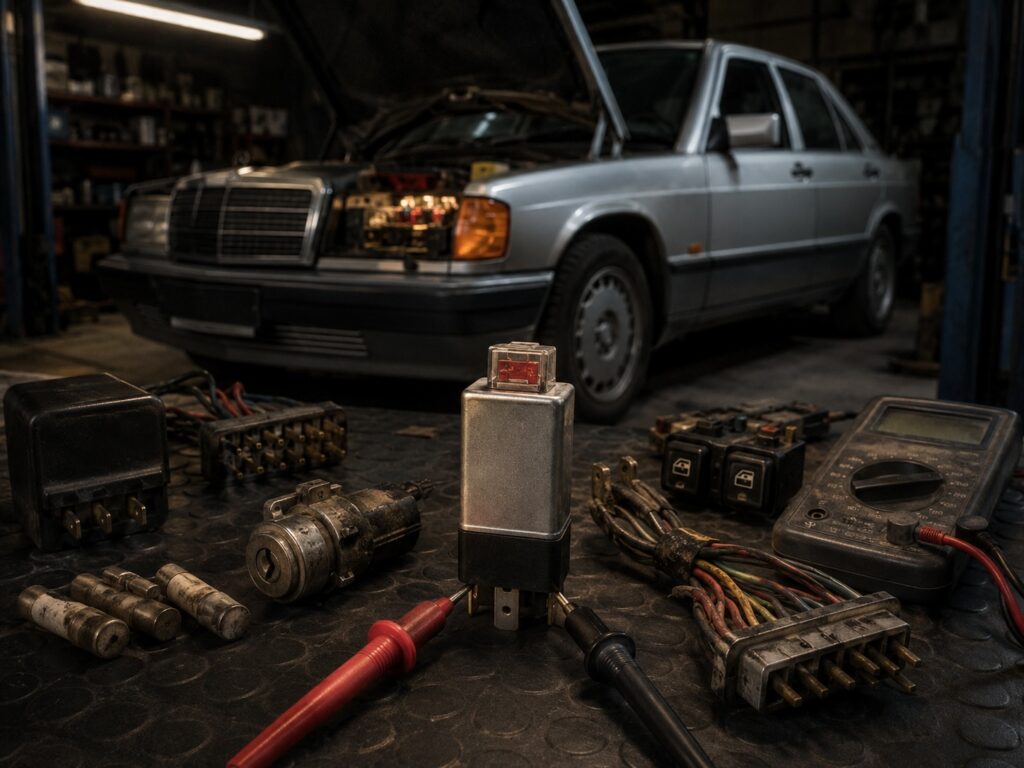
A 190E with rough idle, random stalling, or a glowing ABS light usually needs one £50 part: the OVP (overvoltage protection) relay, found beside the fuse box with a fuse on top. After that, the W201’s electrical faults rank in a short, predictable list: ground straps, the fuel pump relay, vacuum leaks misdiagnosed as electrical, and the ignition switch.
What does the OVP relay do?
The OVP relay feeds stabilised voltage to the KE-Jetronic’s electronic brain and the ABS controller, and it sacrifices itself to protect both from voltage spikes. Mercedes fitted it to every KE-Jetronic car of the era, which is why our registre d'échange lists the same relay across the W124, W126, R107 and G-Wagen.
When it fails, the KE system loses its electronic correction and falls back to crude mechanical running. The symptoms read like a worn-out engine: lumpy idle, hesitation, stalling at junctions, hard warm starts, and frequently an ABS warning light keeping the engine symptoms company. That ABS light paired with rough running is the OVP’s signature, and the reason this relay has cured thousands of “carburettor-feeling” 190Es.
Find it: under the bonnet beside the fuse box, a tall relay with a 10A fuse (or two, on later twin-fuse versions) on its top. Test it: check the top fuse first; a blown fuse is the relay announcing a spike event or its own decline. Swap-test with a known-good relay rather than chasing voltages. Fix it: £40 to £80 for a quality replacement. Match the pin count, since single-fuse and twin-fuse versions both exist. Keep the old one in the boot as a spare if it still works; it makes a roadside diagnostic tool.
The W201 electrical fault list, ranked
After the OVP, the faults rank by frequency. Work the list in order and you fix most cars before the multimeter comes out.
1. Ground straps. The engine-to-body and battery-to-body grounds corrode at their ends after three decades. Symptoms wander: slow cranking, dim lights at idle, gauges that sag when the blower runs. The fix costs an hour with a wire brush and copper grease at every strap and ground point. Do this before diagnosing anything else electrical; bad grounds forge other components’ symptoms.
2. Fuel pump relay. The other relay that strands W201s. Dead pump, no start, no prior warning, often intermittent in heat. Listen for the two-second pump prime at key-on; silence means relay or pump, and the relay is the cheap first swap. Dry solder joints inside are the usual cause, and the brave resolder them for free.
3. “Electrical” faults that are vacuum leaks. KE-Jetronic cars idle badly when any of the engine bay’s thirty-year-old vacuum lines crack. Owners chase sensors; the car needed £40 of silicone line. Rough idle plus shift-quality complaints on automatics points here, because the 722.4’s modulator drinks from the same vacuum supply. The calendrier de maintenance treats the full vacuum line set as a buy-it-then-baseline item.
4. Ignition switch. The electrical portion of the steering lock wears, and accessories drop out or the car dies and restarts as the key shifts in the barrel. Wiggle-test the key with the engine running. Replacement is fiddly behind the dash but the part stays affordable through the shared W124/W126 lock family.
5. Instrument cluster grounds and the fuel gauge. A fuel needle that swings or reads empty with fuel aboard is usually the tank sender’s worn track or the cluster’s ground, not the gauge. The sender is a known consumable; clean its connector before buying one.
6. Ceramic fuses. The era’s aluminium-strip fuses oxidise where they touch the holders, creating resistance faults that look like dying motors: slow wipers, lazy windows, a weak blower. Twist every fuse in its holder as a five-minute service, and replace the set with modern copper-top equivalents, which fit all era fuse boxes per the registre d'échange.
7. Headlight wiper motors and the rear aerial. Code 600 wiper motors seize from disuse, and the Hirschmann aerial’s nylon mast strips. Both are shared-parts fixes, neither strands the car, and both appear on the fiche technique option list often enough to matter to originality buyers.
The toolkit: what you need and what to avoid
The whole gremlin list above surrenders to four tools: a multimeter (any £20 unit), a wire brush, copper grease, and a known-good spare for each of the two relays. Add a vacuum gauge if you want to settle the leak question in minutes instead of guesses.
One caution from the modern toolbox: old-style test lamps draw real current, and probing the KE-Jetronic’s control side with one can damage what you’re diagnosing. Use the multimeter’s voltage mode on anything connected to an ECU, and save the test lamp for lights, motors and heated rear windows, where its bluntness is a feature.
The W201 rewards the swap-test over the measurement on its relays. Carrying a spare OVP and fuel pump relay in the glovebox converts the two most common roadside failures into two-minute fixes, and the pair costs less than one recovery call-out.
A worked example: the £45 cure
A pattern that repeats across the community, worth walking through because it teaches the method. A member buys a 2.0 with a wandering idle, a hesitation under light throttle, and an ABS light that visits on warm days. The seller priced these symptoms as “needs carbs looked at,” which is its own diagnosis of the seller, since the car has no carburettors.
Step one, the fuse on top of the OVP relay: intact but loose in its holder, with oxide on the caps. Cleaned and reseated, the ABS light retreats but the idle stays lumpy. Step two, the swap-test: a £45 replacement OVP, because the original was a 1989 unit running on borrowed time regardless. Idle improves, hesitation survives. Step three, the ground straps: the engine-to-body strap’s bolt turns out finger-tight in corroded threads. Ten minutes with the wire brush and copper grease, and the hesitation leaves with the last of the symptoms.
Total spend: £45 and ninety minutes, against the £400 of sensors the previous owner had been quoted. The order mattered more than the parts: fuse, relay, grounds, then and only then anything expensive. That order is this article in one sentence.
How do you diagnose a no-start, in order?
The W201 no-start tree is short. Work it before parts-cannon spending.
- Crank, no fire, no pump prime at key-on: fuel pump relay first, then the pump itself, then the OVP.
- Crank, no fire, pump primes: ignition side. Cap, rotor and leads (60,000 km items), then the crank position sensor on later cars.
- No crank, lights dim: battery terminals and ground straps before any starter diagnosis.
- No crank, lights healthy: ignition switch electrical portion, then the starter’s own connections.
- Starts then dies immediately: OVP relay, classically.
Every step above costs under £100 except the pump. Most W201 no-starts resolve at steps one through three.
What does the electrical overhaul cost?
A full preventive sweep, the kind that ends gremlin ownership, prices like this in 2026:
| Emploi | Parts | Notes |
|---|---|---|
| Relais OVP | 40 £ – 80 £ | Match single vs twin fuse |
| Fuel pump relay | £25 – £60 | Or resolder, free |
| Ground strap service | £15 | The highest value hour on the car |
| Full vacuum line set | £40 | Silicone, cut to length |
| Copper-top fuse set | £10 | Replace all |
| Tête d'allumeur, rotor, faisceau de câbles | 80 £ – 140 £ | Service item anyway |
| Ignition switch (electrical) | £40 – £70 | Plus patience |
Under £400 in parts buys a W201 with the electrical certainty of a modern car. The same money spent reactively, one breakdown at a time, buys the same parts plus recovery-truck memberships.
When the fault isn’t electrical at all
Three impostors send owners down the electrical rabbit hole, and ruling them out early saves the weekend.
Fuel quality and age. A car that sat for a year runs every “electrical” symptom on this list because the fuel went stale. Fresh fuel, a new filter, and an Italian tune-up resolve more wandering idles than any relay. Modern ethanol blends also harden old fuel hoses from the inside; weeping hose unions read as lean-running “sensor” faults.
The idle control valve. It’s electrically operated, so it gets blamed electrically, but nine times out of ten it’s mechanically gummed rather than electronically dead. Carb cleaner through the valve and a clean throttle body restore more idles than replacement valves do. Test by unplugging it warm: if the idle barely changes, the valve was stuck regardless of what the wiring carries.
Engine mounts. A collapsed mount transmits vibration the cabin reads as misfire. If the “rough idle” smooths in Drive with the brakes held, or worsens in reverse on a hill, look under the engine before behind the dash. Mounts are schedule-age items on every surviving W201, per the maintenance schedule’s rubber-refresh rule.
The discipline that separates an afternoon from a season: change one thing, drive, write down what changed. The W201 is honest under interrogation; it only lies to owners who ask three questions at once.
Why does the W201 age so well electrically?
The car predates the biodegradable-insulation looms that plague mid-1990s Mercedes, carries no body computer to fail, and routes everything through serviceable relays and visible grounds. Faults are component-sized, parts cross half the Mercedes range, and the registre d'échange keeps the prices honest. An afternoon and the ranked list above beats any diagnostic subscription this chassis will ever need.
Foire aux questions
Where is the OVP relay on a 190E? Next to the under-bonnet fuse box: the tall relay with a fuse (or two) mounted on top.
What are OVP relay failure symptoms? Rough idle, hesitation, stalling, hard warm starts, and often an ABS light alongside. Rough running plus ABS light is the classic pairing.
Can I drive with a failed OVP relay? The car runs in mechanical fallback, badly, and ABS is offline. Drive to the parts counter and no further.
Why does my 190E stall at junctions? OVP relay first, vacuum leaks second, idle control valve third. In that order, by cost.
Why is my fuel gauge erratic? Tank sender wear or cluster grounding, in that order. Clean connections before buying parts.
My wipers and windows are slow. Motors? Twist the ceramic fuses in their holders first. Oxidised fuse contacts mimic dying motors across this whole era of Mercedes.
Does the W201 have the bad wiring loom? No. The biodegradable-insulation looms arrived on mid-1990s models. W201 looms age conventionally.
What’s the one preventive electrical job to do today? Ground straps. An hour and £15, and half the gremlin catalogue never visits.
Which spares belong in the glovebox? An OVP relay, a fuel pump relay, a handful of copper-top fuses, and the 10A fuse the OVP wears on top. Under £100 total, and the two failures that strand W201s become two-minute roadside swaps.
Are W201 electrical parts still available? Yes, and cheaply, because nearly everything crosses to the W124, W126 and R107 per the registre d'échange. The relay family stayed in production for decades across the range.
Prends ceci avec toi
Vous avez une 190 ?
Soumettez votre build et nous le mettrons en avant sur nos chaînes YouTube, TikTok et Instagram.
Démarrez votre garage →