
Tous les moteurs de la Mercedes-Benz 190E, classés par fiabilité : M102, M103, OM601, OM602
The most reliable Mercedes-Benz 190E engine is the OM601 four-cylinder diesel. Among petrol units, the M102 eight-valve 1.8 and 2.0 are the most durable. The M103 inline-six is exposed to head-gasket failure beyond 250,000 km. The Cosworth 16-valve M102 derivatives demand specialist maintenance.
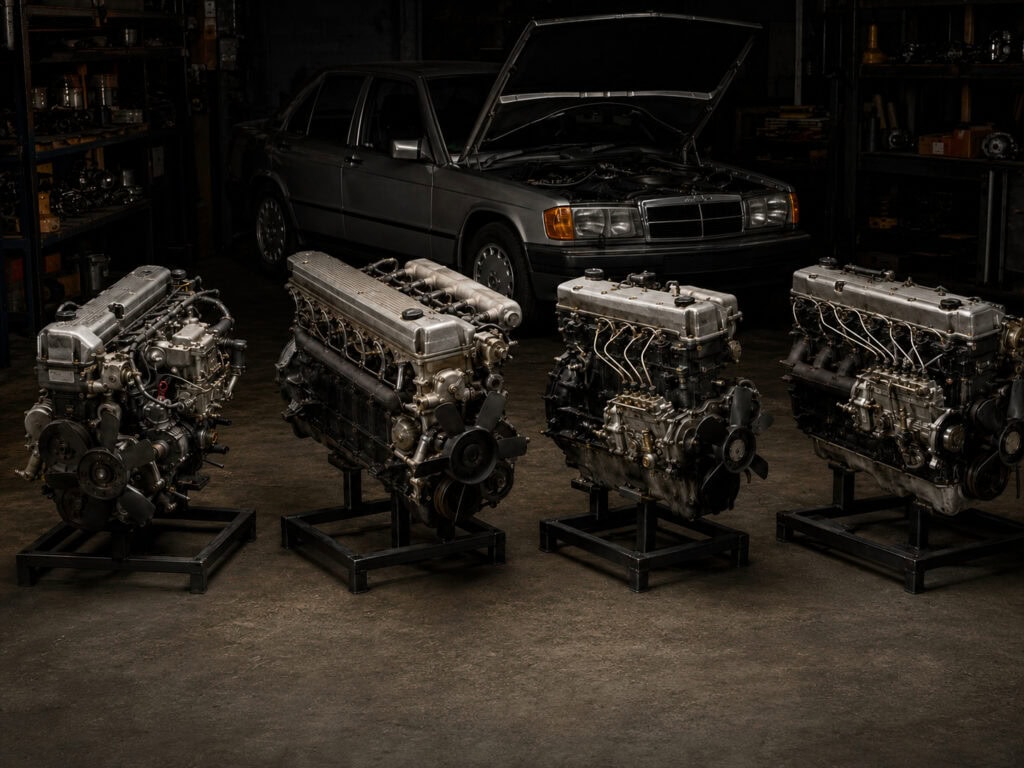
The most reliable Mercedes-Benz 190E engine is the OM601 four-cylinder diesel, with documented examples exceeding 500,000 km on original internals. Among petrol units, the M102 eight-valve 1.8 and 2.0 are the most durable. The M103 2.6 inline-six is mechanically solid but exposed to head-gasket failure beyond 250,000 km. The Cosworth 16-valve M102 derivatives are durable when maintained by specialists and unforgiving of neglect.
The 190E engine line-up at a glance
The W201 ran from 1982 to 1993. Across eleven years and 1.879 million cars, Mercedes-Benz fitted the 190E with three petrol engine families (M102, M103, AMG 3.2), two diesel families (OM601, OM602), and one Cosworth-developed 16-valve variant of the M102 with three distinct configurations.
The table below ranks every production engine by realistic lifespan with average use, repair cost band, and verdict. Detailed sections follow.
| Rank | Moteur | Années | Sortie | Typical lifespan | Repair cost | Verdict |
|---|---|---|---|---|---|---|
| 1 | OM601.911 (2,0 D) | 1983–1993 | 72 hp | 500,000+ km | Faible | The indestructible. Buy and forget. |
| 2 | M102 8V (1.8 / 2.0) | 1982–1993 | 90–122 hp | 350,000+ km | Faible | The baseline benchmark. |
| 3 | OM602.911 (2,5 D) | 1985–1993 | 90 hp | 450,000+ km | Low–medium | Long-haul specialist. Slow but unkillable. |
| 4 | M102 8V (2.3) | 1984–1993 | 132 hp | 300,000+ km | Faible | Stressed harder than the 2.0. Still durable. |
| 5 | M103.940 (2.6) | 1986–1993 | 160–166 hp | 250,000 km | Medium | Refined six. Head-gasket exposure at high mileage. |
| 6 | M102 16V 2.5-16 | 1988–1993 | 197–204 hp | 250,000 km | Medium–high | The Cosworth sweet spot. Specialist maintenance non-negotiable. |
| 7 | M102 16V 2.3-16 | 1984–1988 | 185 hp | 220,000 km | Medium–high | The original Cosworth. Smaller torque margin, same maintenance burden. |
| 8 | M102 16V 2.5-16 Evo II | 1990 only | 235 ch | 180,000 km | Haut | Short-stroke, race-bred road engine. Demands track-level discipline. |
| 9 | AMG 3.2 (factory + swap) | 1989–1993 | 234 hp | 200,000 km | Very high | Engineering masterpiece. Parts and labour priced accordingly. |
Which 190E engine is the most reliable?
The OM601 four-cylinder naturally aspirated diesel. There is no second-place argument that survives contact with the documented evidence: European taxi-fleet 190 D 2.0 examples exceeded 800,000 km on original blocks, cranks, and heads through the 1990s and 2000s. Mercedes-Benz Classic Centre service records show OM601-equipped W201s in active fleet use into the 2020s.
The engine is iron-block, indirect-injection, mechanical fuel pump, no electronics in the combustion path. Failure modes are predictable: glow plugs at 80,000 km intervals, vacuum pump diaphragm at 250,000 km, injector pop pressure at 300,000 km. Every failure mode is bench-rebuildable. Parts are still produced by Bosch and Bremi. The OM601 is what the 190E was over-engineered around.
Verdict: if reliability is the priority above all other criteria, buy a 190 D 2.0.
M102 8-valve petrol (1.8, 2.0, 2.3): the baseline benchmark
Codes: M102.910 (1.8 carb), M102.912 (1.8 EFI), M102.920 (2.0 carb), M102.961 (2.0 EFI), M102.985 (2.3 EFI).
Output: 90 hp (1.8 carb) to 132 hp (2.3 EFI).
Architecture: iron block, alloy head, two valves per cylinder, single-overhead-cam driven by duplex chain. KE-Jetronic (mechanical-electronic) fuel injection on most variants; carburetted versions through 1988.
The M102 is the engine the W201 was designed around. The combustion chamber, valvetrain, and oil galleries trace directly to the early 1980s Mercedes development programme for a compact-car powerplant that could survive German taxi-fleet duty. It survived it.
Known failure modes:
- Cylinder head warping at 200,000+ km on hard-driven 2.3 examples. Symptom: rough idle, coolant loss without external leak. Repair: head machined flat, new MLS gasket, head bolts replaced. Cost band: £600 – £900 in 2026.
- Timing chain stretch at 180,000+ km. Symptom: rattle on cold start that disappears after 5 seconds. Repair: duplex chain + tensioner + rails, around £400 in parts. The job is straightforward.
- Vacuum line perish across the engine bay at 30+ years old. Symptom: rough idle, fluctuating boost on the rare turbo-conversion examples, transmission shift quality decline. Repair: silicone vacuum line kit, £40, two hours.
- KE-Jetronic fuel distributor failure at 250,000+ km. Symptom: fuel pressure off-spec, won’t idle, lean condition. Repair: rebuilt unit £450 from Bosch specialists.
Service interval the W201 community follows: oil and filter every 8,000 km on hard-driven examples, every 12,000 km on commuters. Valve clearance check every 40,000 km. The M102 has hydraulic lifters from 1988 onward, mechanical before, so the check applies to early cars only.
Parts availability in 2026: strong. Mercedes-Benz Classic stocks all major service items. Aftermarket support from Febi, Hella, Bosch, Mahle, and Mann is comprehensive.
Verdict: the M102 8V is the easiest 190E engine to live with. A clean 2.0E with documented service history is the safest W201 purchase under £8,000.
M102 16-valve Cosworth (2.3-16): the original
Codes: M102.983.
Output: 185 hp (Euro spec), 167 hp (US KAT-spec catalytic-converter variant).
Architecture: M102 short block, Cosworth-designed twin-cam 16-valve cylinder head, KE-Jetronic with sport ECU mapping, dry-sump optional on factory race cars. Bosch ignition with revised distributor for higher redline.
The 2.3-16 was developed by Cosworth Engineering in Northampton from 1981, debuted in production form at the 1983 Frankfurt Motor Show, and homologated for Group A by 1984. The head castings ship with “COSWORTH” embossed externally. The engine ran the Nardò endurance record runs in August 1983 (50,000 km flat-out at 247 km/h average).
Known failure modes:
- Cam follower bucket wear at 80,000 km if oil change intervals are stretched. Symptom: top-end clatter under load. Repair: head off, new buckets and shims set, £900 – £1,400.
- Timing chain stretch identical to the 8-valve M102, but on a more expensive cylinder head to reach. Failure to address it under-stresses the cams and accelerates bucket wear.
- KE-Jetronic warm-up regulator failure at 150,000+ km. Symptom: rough cold-start, mixture off-spec. Repair: rebuilt unit £350 – £500.
- Exhaust manifold cracking at 200,000+ km from thermal cycling. Repair: stainless replacement manifold, £600 – £1,100 depending on supplier.
Service interval: valve clearance check every 30,000 km. This is the single most important service item on any Cosworth 190E. Skipped valve adjustments are why most 2.3-16s with neglected service histories run roughly. Oil change every 6,000 km on hard use; the 16-valve head punishes oil degradation harder than the 8-valve.
Parts availability: moderate. Engine internals available through Mercedes-Benz Classic and specialist rebuilders (notably Cosworth Heritage Engines, the parts subsidiary of the original engineering firm). KE-Jetronic components increasingly only via rebuilders. The 2.3-16 head gasket part number is still in production.
Verdict: a maintained 2.3-16 is a brilliant road car. A neglected 2.3-16 is the most expensive engine on this list to make right.
M102 16-valve Cosworth (2.5-16 and Evolution I): the sweet spot
Codes: M102.990 (standard 2.5-16 and Evolution I).
Output: 197 hp (Euro), 195 hp (Evolution I).
Architecture: stroked from the 2.3-16 to 2.5 litres for additional torque in DTM trim. Cosworth head retained, slightly revised port geometry. Bore 95.5mm, stroke 87.2mm.
Introduced for the 1988 model year as the 2.3-16 replacement. The Evolution I (1989, 502 units) added wider bodywork, revised wheel arches, deeper splitter, and engine-internal changes for DTM homologation but retained the standard 2.5-16 head and bottom end for road-going emissions compliance.
Reliability vs the 2.3-16: broadly identical maintenance requirements. The 2.5-16 has slightly more thermal headroom (lower specific output relative to displacement) and is the marginally more durable of the two Cosworth road engines.
Service intervals: identical to the 2.3-16. Specialist maintenance is non-negotiable.
Parts availability: the 2.5-16 head shares most components with the 2.3-16, including valves, buckets, and gaskets. Evolution I-specific hardware (e.g. the lightweight pistons in select examples) is rare and expensive.
Verdict: the 2.5-16 is the Cosworth 190E most owners actually want. Standard 2.5-16 examples in 2026 trade between £18,000 and £42,000 depending on condition. Evolution I examples have crossed £180,000 at auction.
M102 16-valve Cosworth (2.5-16 Evolution II): the road race car
Codes: M102.991.
Output: 235 hp at 7,200 rpm.
Architecture: short-stroke variant of the 2.5-16. Bore 97mm, stroke 84.5mm. Reworked head ports, larger valves, redesigned intake. The shortest-stroke Cosworth 16-valve ever fitted to a road-going Mercedes. The redline lifted from 6,700 to 7,200 rpm.
The Evolution II was built in 502 units, the FIA Group A homologation threshold. It debuted at the Geneva Motor Show on 12 March 1990. The engine was designed to live at sustained DTM operating speeds, not commuter loads.
Reliability reality: the Evolution II road engine is the most stressed M102 ever produced. Bearings see higher peak loads, oil temperature runs hotter in traffic than the 2.5-16 because the engine prefers airflow at speed. Documented road-going lifespan to first bottom-end overhaul on stock internals: 150,000 to 200,000 km depending on use.
Service intervals: the W201 community treats the Evolution II as a track engine that happens to be road-legal. Oil change every 4,000 km. Valve adjustment every 20,000 km. Full top-end inspection every 60,000 km. Coolant change every 24 months without exception.
Parts availability: poor. Evolution II specific internals are unobtainable except through specialist rebuilders. A bottom-end overhaul on a numbers-matching Evolution II in 2026 starts at £18,000.
Verdict: the Evolution II is a road-legal race engine. Treat it as one or do not buy one. A correctly maintained Evolution II crossed £450,000 at RM Sotheby’s Monaco 2024.
M103.940 (2.6 inline-six): refinement vs head-gasket exposure
Codes: M103.940.
Output: 160 hp (Euro), 158 hp (US 168 hp post-1989 catalyst revision).
Architecture: all-alloy 2,599 cc inline-six, single-overhead-cam, 12-valve, KE-Jetronic. Shared with the W124 260E. The 190E 2.6 was sold as the luxury six-cylinder W201 for buyers who wanted M-B refinement in the compact chassis.
Known failure modes:
- Head-gasket failure at 200,000 to 280,000 km. The M103 head gasket is the single most discussed failure on the engine. Symptom: white exhaust smoke, coolant loss, oil emulsion in the rocker cover. Repair: head off, machined flat, new MLS gasket, head bolts replaced, around £1,200 to £1,800 in 2026.
- Timing chain rail wear at 180,000+ km on neglected oil-change cars. Symptom: chain rattle at start. Repair: front cover off, new rails and tensioner, £800.
- Distributor cap and rotor failure at long intervals. Symptom: misfire under load. Trivial repair.
- KE-Jetronic fuel distributor and warm-up regulator failures identical to the M102 KE-Jetronic units.
Service interval: oil change every 8,000 km. Coolant change every 24 months. Valve clearance: not required (hydraulic lifters). The head gasket is the only failure mode worth budgeting for in advance.
Parts availability: very strong. The M103 shared so many components with the W124 line that aftermarket support remains comprehensive.
Verdict: a 190E 2.6 with a documented head-gasket replacement at a known shop is one of the best long-distance W201 purchases possible. Without that documentation, budget £1,500 within the first 30,000 km of ownership.
OM601.911 (2.0 D): the indestructible
Codes: OM601.911.
Output: 72 hp.
Architecture: all-iron 1,997 cc four-cylinder indirect-injection diesel. Mechanical Bosch in-line injection pump (M-pump). No electronics. No turbocharger. No catalytic converter on European-spec cars.
Known failure modes:
- Glow plug failure at 80,000 km intervals. Cost: £15 per plug.
- Vacuum pump diaphragm failure at 250,000 km. Cost: £45.
- Injector pop pressure drift at 300,000 km. Service: pop test and re-shim, £80 per injector.
- Bosch injection pump internal wear at 500,000 km. Rebuild: £600.
That is the failure list. Nothing else on this engine has a recurring failure record. The block, head, crank, rods, pistons, and timing components have documented service life beyond one million kilometres in fleet records.
Service interval: oil change every 10,000 km. Glow plugs every 80,000 km. Air filter every 30,000 km. Fuel filter every 20,000 km. That is the entire maintenance schedule.
Verdict: if the goal is to own a W201 for thirty years, the OM601 makes the case for itself. Slow, loud, characterful, indestructible.
OM602.911 (2.5 D): long-distance specialist
Codes: OM602.911 (naturally aspirated), OM602.961 (turbo, late-1980s).
Output: 90 hp (NA), 122 hp (turbo).
Architecture: five-cylinder indirect-injection diesel, shared block architecture with the OM601 (one extra cylinder). The turbo variant is rare in the W201, more common in the W124.
Reliability: marginally less indestructible than the OM601 only because the five-cylinder configuration introduces an asymmetric firing order that raises bearing loads. OM602 examples reach 400,000+ km as a matter of course. The turbo OM602.961 introduces additional failure modes (turbo bearing wear at 250,000 km, charge-air pipework cracking) but remains a long-life engine.
Verdict: if the OM601 2.0 is too slow, the OM602 NA 2.5 is the obvious upgrade with minimal reliability cost. Avoid the turbo variant unless service history is complete.
AMG 3.2 (factory and swap)
Codes: AMG-modified M103.
Output: 234 hp.
Architecture: AMG-developed 3.2-litre version of the M103 inline-six. Bored to 91mm, stroked to 80mm. Aftermarket-spec head, sport camshaft, free-flow intake and exhaust. The factory 190E 3.2 AMG was built in low volume (numbers debated; widely cited as 200 cars between 1989 and 1993).
Reliability: the engineering is genuine factory quality. The variance in real-world reliability comes from two sources: post-purchase modification (many 3.2 AMG cars left the factory bone-stock and were modified further by owners), and the cost of correct maintenance. AMG specialists charge accordingly.
Verdict: the AMG 3.2 is owned by people who can afford the upkeep. Service costs run two to three times the standard M103 2.6. Parts pipeline runs through AMG Affalterbach and a small network of independents.
Service interval matrix (one table for every engine)
| Article | M102 8V | M102 16V | M103 2.6 | OM601 | OM602 | AMG 3.2 |
|---|---|---|---|---|---|---|
| Oil change (hard use, km) | 8,000 | 6,000 (4,000 Evo II) | 8,000 | 10,000 | 10,000 | 6,000 |
| Coolant change (months) | 24 | 24 | 24 | 36 | 36 | 24 |
| Valve clearance check (km) | 40,000 (pre-1988) | 30,000 (20,000 Evo II) | n/a (hydraulic) | 40,000 | 40,000 | 30,000 |
| Timing chain inspection (km) | 100,000 | 60,000 | 100,000 | 100,000 | 100,000 | 60,000 |
| Fuel filter (km) | 30,000 | 20,000 | 30,000 | 20,000 | 20,000 | 20,000 |
| Spark plugs (km) | 30,000 | 20,000 | 30,000 | sans objet | sans objet | 20,000 |
| Glow plugs (km) | sans objet | sans objet | sans objet | 80,000 | 80,000 | sans objet |
How to choose
For the lowest total cost of ownership: OM601 2.0 D ou M102 8V 2.0E.
For the best balance of performance and reliability: M103 2.6 (with budgeted head-gasket replacement) or M102 8V 2.3.
For the Cosworth experience: M102 16V 2.5-16 standard variant, with documented service history including recent valve adjustment and timing chain inspection.
For a collector investment: Évolution I ou Évolution II with original engine, original paint, and full Mercedes-Benz Classic Centre documentation. These are not road cars in any practical sense.
For an AMG: only with full documentation, full service history, and a £30,000 buffer for unforeseen service items.
Foire aux questions
Which Mercedes 190E engine lasts the longest?
The OM601 2.0-litre naturally aspirated diesel. Fleet records and Mercedes-Benz Classic Centre data show routine service lives of 500,000 to 800,000 km on original internals when basic maintenance (oil, glow plugs, vacuum diaphragm) is performed on schedule.
Are Cosworth 190E engines reliable?
Yes, when maintained by a specialist. The Cosworth 16-valve M102 cylinder head requires valve clearance adjustment every 20,000 to 30,000 km. Owners who skip this service experience accelerated cam-follower wear, top-end clatter, and head removal costs in the £1,000 to £1,500 range. Owners who maintain the engine correctly see 220,000 to 250,000 km between top-end overhauls.
Is the 190E 2.6 reliable?
Mechanically yes. The M103 inline-six is durable and refined. The known weakness is head-gasket failure between 200,000 and 280,000 km. Budget £1,200 to £1,800 for the repair when the gasket fails, or pay a small premium for a 190E 2.6 with documented head-gasket replacement already performed.
How much does it cost to maintain a 190E Cosworth?
Routine annual maintenance on a non-Evolution Cosworth 190E ranges between £800 and £1,400 in 2026 if performed by a Mercedes specialist. Major top-end work every 80,000 km adds £1,200 to £1,800. Evolution II maintenance costs run roughly double these figures because of parts scarcity and required specialist labour.
Should I buy a 190E diesel or petrol?
For daily use over long distances, a 190 D 2.5 (OM602) is the most practical choice: 4.5 to 5.5 litres per 100 km, 800 km tank range, indestructible drivetrain. For weekend use or any car that will not exceed 8,000 km annually, a petrol M102 8V is the lower-cost purchase and equally durable. The 190E 1.8 / 2.0 is the easiest 190E to live with from a parts and service standpoint.
What kills a 190E engine?
Three causes account for almost all premature engine failure on a 190E: neglected oil changes (especially on the 16-valve Cosworth), unaddressed head-gasket failure on the M103 (driven with coolant loss), and unaddressed timing chain stretch (eventually a chain skip and bent valves). All three are detectable on inspection. All three are preventable.
Can you still get parts for a Mercedes 190E engine?
Yes. Mercedes-Benz Classic Centre stocks every major service component for every 190E engine variant. Aftermarket support from Bosch, Bremi, Febi, Mahle, Mann, and Hella covers virtually all routine service items. Cosworth 16-valve specific internals are increasingly only available through specialist rebuilders, but they remain available.
Is the 190E Evolution II engine reliable enough for daily driving?
Technically yes, in practice no. The Evolution II engine was designed for sustained DTM operating speeds and is over-stressed in commuter traffic. Most Evolution II owners restrict their cars to occasional dry-weather use to preserve engine life and originality. The car retains its value when it is not used as a daily.
What is the most reliable petrol 190E engine?
The M102 8-valve in 2.0-litre fuel-injected form (190E 2.0). Lower specific output than the 2.3 means lower thermal and mechanical stress. Examples in regular use commonly exceed 350,000 km on original internals with no significant work beyond timing-chain refresh and standard service items.
Sources: Mercedes-Benz Classic Centre technical archive; Cosworth Engineering historical reference; Bosch fuel injection system service documentation; Mercedes-Benz Club archives (UK, Germany, US); period road tests in Autocar (1984, 1988, 1990), Auto Motor und Sport (1983, 1990), Car Magazine (1988, 1990); RM Sotheby’s auction results 2018–2024.
Prends ceci avec toi
Vous avez une 190 ?
Soumettez votre build et nous le mettrons en avant sur nos chaînes YouTube, TikTok et Instagram.
Démarrez votre garage →