
Nardò 1983: 50,000 Kilometres Flat Out in the First Cosworth 190E
In August 1983, three near-standard Mercedes 190E 2.3-16 prototypes circulated the Nardò bowl in southern Italy for eight days, covering 50,000 km at an average of 247.9 km/h and breaking three world endurance records. The run announced the Cosworth engine before the road car's Frankfurt debut and built the durability legend the 16v cars still trade on.
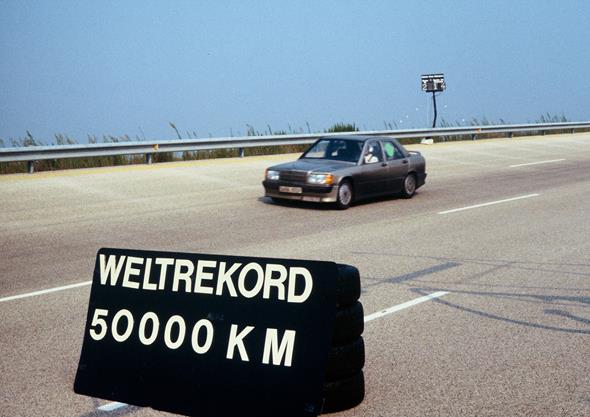
In August 1983, three near-standard Mercedes 190E 2.3-16 prototypes circulated the Nardò bowl in southern Italy for eight days, covering 50,000 km at an average of 247.9 km/h and breaking three world endurance records. The run announced the Cosworth engine before the road car’s Frankfurt debut and built the durability legend the 16v cars still trade on.
What happened at Nardò?
Mercedes took three 190E 2.3-16 development cars to the Nardò Ring, the 12.6 km high-speed bowl near Lecce, in the August heat of 1983. The plan had the shape of a bet: run the unreleased Cosworth-engined car at maximum sustainable speed, day and night, until 50,000 kilometres passed under it, and let the timing equipment write the launch publicity.
The cars ran for just under nine days of elapsed time, eight of them at speed, through ambient temperatures the team recorded around 40°C. Drivers rotated in shifts; stops covered fuel, tyres, scheduled oil changes and driver swaps, and the average including every stop still held at 247.94 km/h. When the distance counter passed 50,000 km, the three cars had taken the world records for 25,000 km, 25,000 miles and 50,000 km, plus a list of international class records along the way.
The detail that made the story: these were recognisably the cars customers would buy. Production-specification engines, road tyres of the period, saloon bodies with their windscreen wipers and door handles in place. Stuttgart’s message needed no copywriter: the engine you can order survives a month of full throttle compressed into eight days.
Why did Mercedes need the run?
The 2.3-16 carried an unusual burden for a Mercedes. The company had commissioned Cosworth’s 16-valve head for a rally programme that died when Audi’s Quattro rewrote rallying’s rules, leaving a high-revving homologation engine without a competition home and a conservative customer base that had never bought a twitchy Mercedes four. The brand’s pre-war racing glory was forty years old; its post-1955 motorsport absence was still policy.
Nardò solved both problems in one event. For the cautious customer, the run proved the exotic head carried Mercedes durability: the engine that revved like a race unit had just outlasted any sane ownership pattern in public, on the record. For the company, it re-entered competition through the side door of record-breaking, a Mercedes tradition since the 1930s that required no grid, no rivals and no risk of losing. One month later the 2.3-16 appeared at the Frankfurt show with its credibility pre-installed, and the DTM programme that followed had its foundation myth.
What were the cars?
Development prototypes built to production specification in the places that mattered. The M102.983 engines ran the same Cosworth-cast head, the same 185 hp Euro tune and the same KE-Jetronic injection the customer cars would carry; the reliability reference traces the production engine’s service profile straight back to this proof. Aerodynamic preparation stayed within what the road car offered, since the 2.3-16’s body addenda existed for exactly this kind of sustained speed. The cars wore period road-legal tyres, consumed them on schedule, and held the bowl’s banking at a near-constant throttle that loaded the cooling, oiling and valvetrain harder than any customer ever would.
The 50,000 km translated to roughly 200 hours at an average above 240 km/h: the equivalent of a European owner’s first eight years of driving, executed without a night off, in Puglian summer heat. Three cars started; three finished.
What records fell?
| Record | Distance | Result |
|---|---|---|
| World record | 25,000 km | Set, ~247.9 km/h average |
| World record | 25,000 miles | Set |
| World record | 50,000 km | Set, 247.94 km/h average |
| International class records | Various intermediate distances | A further list of class marks fell during the run |
Record runs at Nardò measure averages including every stop, which is what makes the figure brutal: a car must lap at well above the average to bank time against fuel stops, tyres and driver changes. The 2.3-16’s lap speeds on the banking ran far closer to its 230 km/h road-car maximum than any owner’s manual would recommend, for eight days.
Inside the run: what eight days at 247 km/h takes
A record attempt at this scale runs on logistics more than heroics. The team operated Nardò like a around-the-clock pit lane: driver stints of a few hours apiece in rotation, refuelling choreographed to the minute because every stationary second drags the average down, tyre changes on a schedule set by the banking’s constant load, and oil services performed against the clock with the records’ arithmetic on a board. Engineers logged temperatures and consumption every lap of the way; the data fed straight back into the production engine’s release.
The bowl added its own punishments. Nardò’s banking lets a car hold speed with minimal steering input, which sounds restful and is the opposite: drivers fight monotony, heat and the constant lateral load, at night, at over 240 km/h, with southern Italy’s August radiating off the concrete. The cars never cooled; heat soak became a design input. That the three road-specification cooling systems held for eight such days taught Mercedes more than any test rig, and the production 2.3-16 shipped with the lesson included.
Where Nardò sits in the Mercedes record tradition
Stuttgart had used record runs as engineering theatre for half a century: the streamliners of the 1930s, then the C111 experimental cars, whose diesel and petrol versions took their own sheaves of records at the same Nardò bowl in 1976 and 1978. The 190E run consciously joined that lineage with one inversion. The C111 was a prototype proving a future; the 2.3-16 was a customer car proving a showroom promise. Records set by something you could order, with a chassis number and a warranty, carried a different weight, and Mercedes marketing spent the following decade quoting them. The W201’s own descendants returned the favour: the durability claim Nardò established became the spine of every 16v review through the DTM years, and it never needed restating because nobody could outrun it.
What did Nardò mean for everything after?
The run wrote three storylines the W201 world still lives in. The first is the durability legend: the reason a maintained Cosworth carries a reputation for toughness that its specialist-maintenance demands would otherwise undermine. The engine demonstrated its ceiling before a single customer tested its floor.
The second is the motorsport door it opened. Frankfurt followed in September 1983, the Senna race at the new Nürburgring followed in May 1984 with the same model, and the homologation path ran through the 2.5-16 to the Evolution II and the 1992 DTM title. Every chapter cites the first one.
The third is quieter: Nardò set the template for how this car earns respect, through documented endurance rather than headline power. It remains the right frame for the model in 2026, when the surviving cars’ odometers tell the same story the timing equipment told in Puglia. The 190E was never the fastest thing on the road. It was the thing still on the road.
The numbers in context
What 247.94 km/h sustained for 50,000 km meant in 1983 is best read against the road car’s own datasheet. The production 2.3-16 topped out at 230 km/h; the record cars averaged faster than that, including every stop, for over a week, on the same engine specification. Era context sharpens it further: 1983’s other compact saloons cruised at 180 km/h flat out, and supercars of the day made headlines with top speeds the 190E prototypes treated as an average.
| Yardstick | Figure |
|---|---|
| Record average, 50,000 km | 247.94 km/h |
| Production 2.3-16 top speed | 230 km/h |
| Distance covered | 50,000 km in ~8 days |
| Equivalent annual mileage | 3 to 4 typical European years, weekly |
| Engines used per car | One |
The last line carried the marketing. Record attempts of the era commonly rotated engines or retired cars; three W201s finishing on three original drivetrains converted an advertising claim into an engineering record the company never needed to embellish.
Frequently asked questions
What speed did the 190E average at Nardò? 247.94 km/h over 50,000 km, including all stops, across roughly eight days of running.
Were the Nardò cars standard? Production-specification in engine and body, as development prototypes ahead of the road car’s launch. The point of the exercise was that customers could buy what the records proved.
How many records did Mercedes set? Three world endurance records (25,000 km, 25,000 miles, 50,000 km) plus a list of international class records along the way.
Where is Nardò? Near Lecce in Puglia, southern Italy: a 12.6 km circular high-speed test track, banked so that cars hold speed hands-off in the upper lanes.
Why August, in 40°C heat? The schedule served the September Frankfurt launch. The heat became part of the proof rather than an obstacle to it.
Did the run break the engines? Three cars started and finished. The engines’ post-run condition fed development of the production 2.3-16, which launched the following month.
Can I see the Nardò cars today? Mercedes-Benz Classic holds the heritage; cars and artefacts from the programme appear in the museum and at anniversary events.
Is this why Cosworth 190Es hold value? It is the foundation of the model’s story, and provenance stories set collector values. The Cosworth comparison covers how that story prices today.
How long did the Nardò run take? Just under nine days elapsed, with roughly 201 hours of running to cover the 50,000 km at the recorded average.
Did the 2.5-16 or Evolution cars set records too? The later cars proved themselves on circuits instead; the record-run role belonged to the 2.3-16 alone. Its successors inherited the credibility rather than repeating the exercise.
Was Nardò the fastest the 2.3-16 ever ran? In sustained terms, yes. Race versions later reached higher peak speeds in DTM trim, but no 16v ever again held speed for days at a time on the record.
Why does an endurance record matter more than a top speed? Anyone can fund one fast lap. Eight days at full throttle measures the engineering margin in everything: cooling, oiling, valvetrain, tyres and the team. That is why Stuttgart chose the format.
Got a 190?
Submit your build and we'll feature it across our YouTube, TikTok and Instagram channels.
Start your garage →