
KE-Jetronic for 190E Owners: How It Works, How It Fails, How to Fix It
KE-Jetronic is Bosch's continuous mechanical injection with an electronic correction layer: an airflow plate meters fuel through a distributor, while an ECU trims the mixture through the electro-hydraulic actuator. It fails through vacuum leaks, tired OVP relays, and worn components at rebuild age. Most "carburettor-feeling" 190Es need £100 of diagnosis discipline, not a £500 fuel distributor.
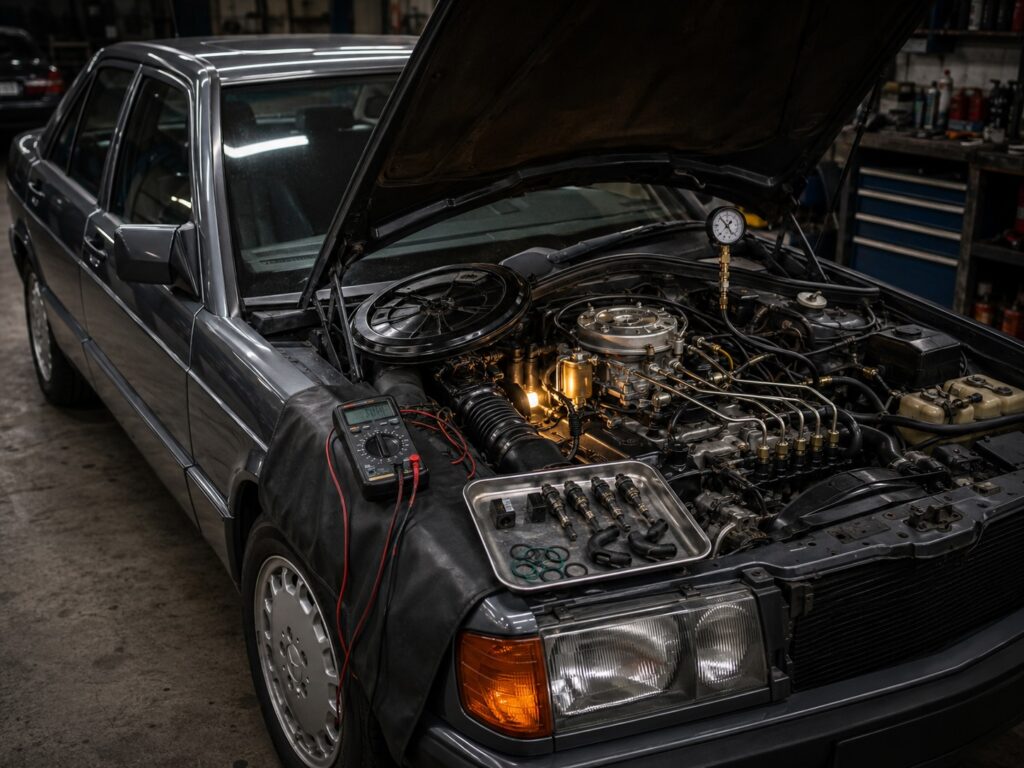
KE-Jetronic is Bosch’s continuous mechanical injection with an electronic correction layer: an airflow plate meters fuel through a distributor, while an ECU trims the mixture through the electro-hydraulic actuator. It fails through vacuum leaks, tired OVP relays, and worn components at rebuild age. Most “carburettor-feeling” 190Es need £100 of diagnosis discipline, not a £500 fuel distributor.
How does KE-Jetronic work, in plain language?
Every petrol 190E meters fuel mechanically. Intake air lifts a circular plate; the plate’s arm moves a plunger inside the fuel distributor; the plunger uncovers ports that send fuel to the injectors continuously, which is the CIS in the system’s other name, Continuous Injection System. More air lifts the plate further and the engine gets more fuel. No computer is required for the engine to run, which is why a 190E with a dead electronic side still drives.
The K became KE when Bosch added the electronic layer. A small ECU reads coolant temperature, throttle position and the lambda sensor, then trims the mechanical baseline through one component: the electro-hydraulic actuator (EHA) bolted to the distributor’s side, which adjusts fuel pressure differentials a few percent either way. Cold enrichment, warm-up correction, lambda control and overrun cut-off all arrive through that one valve.
Hold that architecture in mind and every symptom on this page sorts itself: mechanical-side faults affect the car warm and cold alike, electronic-side faults concentrate in warm-up and fine running, and the OVP relay feeding the ECU sits upstream of the entire electronic layer.
What are the components, and what does each cost?
| Component | Job | Failure age | 2026 cost |
|---|---|---|---|
| Fuel pump + accumulator | Pressure supply, hot-start reserve | 200,000+ km | £150 – £250 |
| Fuel distributor | The mechanical metering heart | 250,000+ km | £450+ rebuilt exchange |
| Airflow plate assembly | Measures intake air | Wear at the pivot, high mileage | Adjust first, rebuild rare |
| EHA valve | Electronic mixture trim | 150,000+ km, or leaks | £180 – £300 |
| Warm-up/pressure regulator | Sets system control pressure | 150,000+ km | £350 – £500 rebuilt |
| Cold start valve | Extra fuel below 35°C | Sticks or leaks with age | £60 – £120 |
| Idle control valve | Idle air bypass | Gums rather than dies | Clean first, £80 – £150 |
| Lambda sensor | Mixture feedback | 100,000 km service item | £40 – £90 |
| OVP relay | Stable power to the ECU | Any age | £40 – £80 |
The rebuilt-exchange economy matters here: Bosch specialists rebuild distributors and regulators to better-than-original tolerances, the cores cross the W124, W126 and R107 per the interchange register, and the exchange route halves the prices owners fear.
Why does a KE car run badly? The diagnosis order
The system earns its reputation from owners who start at the expensive end. Start at the cheap end and most cars never reach the distributor.
- Vacuum integrity. Thirty-year-old lines crack, and KE metering assumes a sealed intake. £40 of silicone line and an hour of replacement beats every sensor on the car. Hissing, a lumpy idle that improves with revs, and poor automatic shift quality all point here.
- The OVP relay. Rough idle plus an ABS light is its signature. Swap-test before measuring anything.
- Fuel pressure and delivery. A weak pump or leaking accumulator causes long hot starts, since the system loses the residual pressure hot restarts depend on. A pressure gauge on the test port settles it in minutes.
- The duty-cycle reading. The diagnostic socket on the inner wing reports lambda trim as a duty cycle; a healthy warm system oscillates around the midpoint. Pegged readings name their own culprit: stuck rich points at temperature sensors or the EHA, stuck lean at intake leaks. One £20 multimeter reading replaces a parts-cannon weekend.
- Mixture baseline. Only after the above, and only with the duty-cycle reading as the guide, adjust the mixture screw between airflow plate and distributor. A car that needs more than a small correction is compensating for a fault elsewhere; find it instead of dialling fuel at it.
What are the classic KE symptoms, decoded?
Long cranking when hot, instant start cold: residual pressure loss. Accumulator, pump check valve, or a weeping cold start valve, in that order. Dies at junctions when warm: OVP first, idle valve gum second. Hesitation on light throttle: vacuum leak or airflow plate rest position, before anything electronic. Strong cold running, rough warm running: the electronic trim layer, since cold running leans on the mechanical baseline. EHA and temperature sensor territory. Fuel smell and high consumption: a rich-stuck system. Check the duty cycle before blaming the distributor; a £25 coolant temperature sensor lies more often than the £450 part does. Fine one day, awful the next, fine again: electrical, not fuel. Grounds and the OVP, per the gremlin guide.
What happens during a cold start?
Watching the system work explains half its faults. Key on: the fuel pump primes for around two seconds, pressurising the lines and the accumulator. Crank: below roughly 35°C coolant temperature, the cold start valve sprays extra fuel into the manifold on a timed burst while the airflow plate begins metering. Fire: the idle valve holds a fast idle, the ECU reads the coolant sensor and commands enrichment through the EHA, and for the first minute the engine runs deliberately rich while the lambda sensor heats to operating temperature. Warm: lambda control closes the loop, the duty cycle starts its healthy oscillation, and the mechanical system runs with a few percent of electronic trim either way.
Each stage owns its failure: no prime points at the pump relay, hard cold starts at the cold start valve or its thermo-time switch, a racing or hunting fast idle at the idle valve, rich running that never leans off at the coolant sensor, and a system that runs worse as it warms at the EHA or the lambda circuit. Ten observed minutes from cold, key to closed-loop, diagnoses more than an afternoon of part-swapping.
The myths that cost owners money
“KE can’t be diagnosed without Bosch dealer tools.” The duty-cycle reading, a fuel pressure gauge and a vacuum gauge cover the system end to end. The factory tools made it faster, never possible versus impossible.
“The fuel distributor is probably dead.” The most-blamed, least-guilty component. Distributors fail at the bottom of the frequency table, after every relay, line, sensor and regulator above them. Price discipline follows diagnosis order.
“Adjusting the mixture screw fixes rough running.” The screw compensates; it does not cure. Every quarter-turn beyond a small correction is a measurement of an unfound fault elsewhere, and the next owner inherits a system tuned around a broken part.
“Modern fuel ruins KE systems.” Ethanol blends harden the era’s rubber lines and seals, which is a hose-replacement note rather than a system indictment. The metering hardware itself runs modern petrol without complaint, as every high-mileage survivor on our index demonstrates.
Is KE-Jetronic worth keeping in 2026?
Yes, and the argument is stronger than nostalgia. A sorted KE system starts, idles and drives indistinguishably from electronic injection, contains no black-box electronics that strand you, and every component on it remains rebuildable. The aftermarket-ECU conversion route costs £1,500 to £3,000, deletes originality the market pays for, and usually gets bought to solve a fault a £40 relay would have cured.
The honest exceptions: heavily modified engines beyond the airflow plate’s metering range, and owners who want modern cold-start manners in arctic climates without maintenance. For everyone else, the system that ran the Nardò records flat-out for eight days will manage the Sunday run.
The ownership rule compresses to one habit: keep the inputs healthy. Stable voltage, sealed vacuum, clean fuel, a fresh lambda sensor at 100,000 km. KE responds to that discipline with decades of anonymity.
The parts strategy that keeps a KE car driving
Owning continuous injection in 2026 rewards a small standing inventory. The glovebox tier: an OVP relay and a fuel pump relay, the two roadside saves. The garage-shelf tier: a vacuum line set, a lambda sensor at its 100,000 km change point, a coolant temperature sensor, and a cold start valve gasket. None of it ages on the shelf, all of it crosses to the next W201, and the set undercuts one specialist diagnostic hour.
Sourcing follows the interchange register’s logic. Relays and sensors come from the general Bosch ecosystem at commodity prices; distributors, regulators and EHA valves come from rebuild-exchange specialists who serve the whole CIS world (Mercedes, Porsche, Audi and VW all ran the family), which keeps that supply alive long-term. The components to buy carefully are the cheap-as-new offers on auction sites: an untested used fuel distributor is a £450 question mark, and the rebuilt one with a warranty costs the difference for a reason.
The long-term picture justifies the discipline. CIS expertise is retiring faster than it is training, and the owners who hold spares, records and a working duty-cycle habit will drive their KE cars untroubled through the gap. The system is not fragile; it is particular, and particular ages well with prepared owners.
Frequently asked questions
What’s the difference between K-Jetronic and KE-Jetronic? K is the purely mechanical system; KE adds the ECU and electro-hydraulic actuator for electronic mixture trim. The 190E range runs KE.
Can a 190E run with the KE electronics disconnected? It runs on the mechanical baseline, badly but drivably. Crude warm running with healthy cold running is the classic signature of a dead electronic layer.
Why does my 190E start hard when hot? Residual fuel pressure loss: the accumulator, pump check valve or a leaking injector seat. Cold starts stay unaffected, which is the tell.
Where is the mixture adjustment on KE-Jetronic? Through the tower between the airflow sensor and distributor, with a long 3 mm hex key. Adjust only against a duty-cycle reading, in tiny increments, engine warm.
How do I read the duty cycle? At the round diagnostic socket in the engine bay, with a multimeter that reads duty percentage. Mid-range oscillation when warm is healthy lambda control.
Are KE-Jetronic parts still available? Service parts, yes; the big components through rebuilt-exchange specialists. Cores interchange across the era’s Mercedes range.
Should I convert to modern EFI? For a standard or lightly tuned road car, no: the conversion costs more than a full KE sort and subtracts value. For heavily modified engines, it becomes a tuning decision rather than a repair.
What single part fixes the most KE problems? The OVP relay, followed by a vacuum line set. Together under £120, and the majority of “KE problems” surrender to one of them.
Take this with you
Got a 190?
Submit your build and we'll feature it across our YouTube, TikTok and Instagram channels.
Start your garage →