
Mercedes 190E vs BMW E30: The Rivalry, Settled With Numbers
Buy the 190E for engineering, durability and value: more advanced rear suspension, stronger long-term reliability, and prices a third below an equivalent E30. Buy the E30 for the livelier drive and the bigger scene. The M3 versus 2.3-16 question runs the other way: the BMW won the showroom war, the Cosworth costs half as much today, and the DTM scoreboard ended level enough to argue about forever.
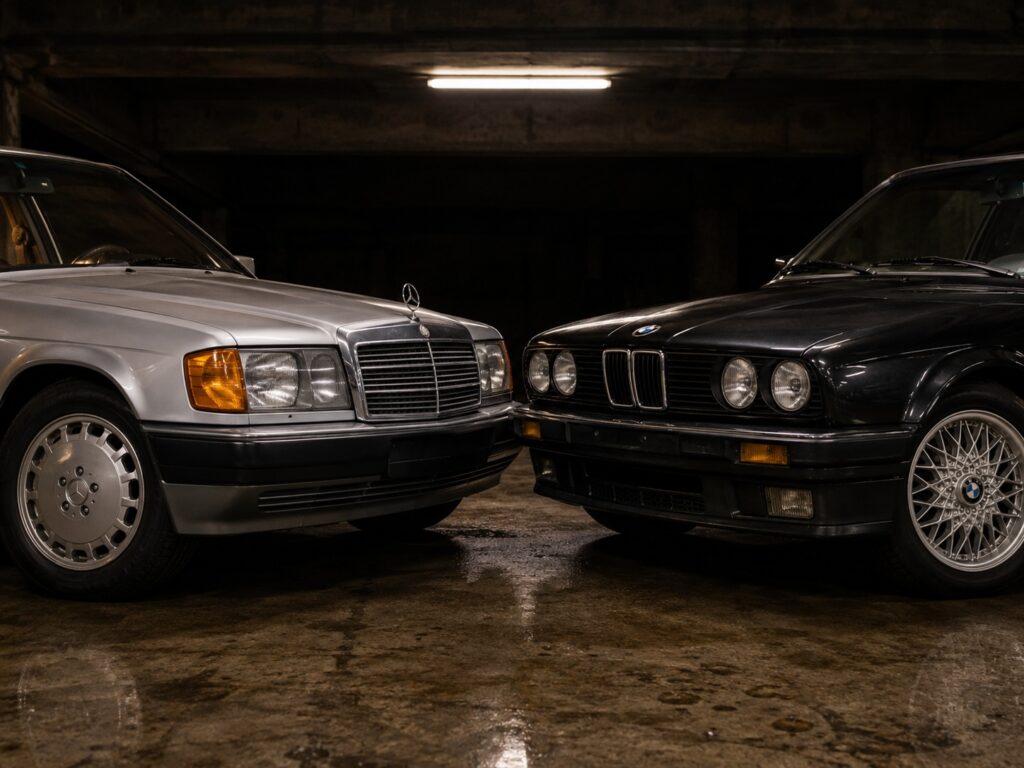
Buy the 190E for engineering, durability and value: more advanced rear suspension, stronger long-term reliability, and prices a third below an equivalent E30. Buy the E30 for the livelier drive and the bigger scene. The M3 versus 2.3-16 question runs the other way: the BMW won the showroom war, the Cosworth costs half as much today, and the DTM scoreboard ended level enough to argue about forever.
The verdict in one table
| Criterion | 190E (W201) | E30 3-Series | Winner |
|---|---|---|---|
| Chassis engineering | Five-link Raumlenker rear | Semi-trailing arm rear | 190E |
| Driving fun, standard cars | Composed, stable | Lighter on its feet, more playful | E30 |
| Long-term durability | The benchmark | Good, but consumes more parts | 190E |
| Price for equivalent condition (2026) | Lower across the range | 30 to 50 percent higher | 190E |
| Parts cost | Cheap, vast interchange | Higher and climbing | 190E |
| Scene and aftermarket | Growing | Enormous | E30 |
| The halo car | 2.3-16 / Evo II | M3 | See below |
How do the chassis compare?
The two cars answered the same brief with opposite philosophies. Munich built the E30 light and simple: MacPherson struts ahead, semi-trailing arms behind, a recipe BMW had refined since the 2002. The result steers with famous immediacy and carries its rear axle’s geometry flaw as a personality trait: under trailing-throttle in a wet corner, the semi-trailing arm’s camber change lets go in a way every E30 forum thread eventually mentions.
Stuttgart spent eight years and a reported two billion marks building the W201 heavy with ideas instead. The Raumlenker five-link rear axle controlled wheel angles through travel in a way nothing at the price matched in 1982, and BMW’s own engineers adopted multi-link for the E30’s successor. The 190E rides better, tracks flatter under load, and forgives mid-corner lifts that flick an E30 sideways.
Which philosophy you prefer is the whole question. The E30 involves you; the 190E protects you. Thirty-five years later both arguments still hold at every cars-and-coffee in Europe.
Which is more reliable in 2026?
The 190E, and the gap is structural rather than anecdotal. The W201’s engines came from taxi-grade families: the reliability ranking documents OM601 diesels beyond 500,000 km and M102 petrols beyond 350,000 km on schedule servicing alone. The E30’s M40 four suffers known camshaft wear, the M20 six wants its timing belt every 60,000 km without forgiveness (the M102/M103 run chains), and the smaller BMW engines work harder for the same pace.
Body durability divides the same way. Both rust, but the W201’s pattern is the predictable six-location map while the E30 adds battery trays, shock towers and the infamous rear screen surround at a higher background rate. Interior plastics age in Mercedes’s favour too; an E30 dashboard without cracks is a selling point, a W201 dashboard without cracks is normal.
E30 ownership is not hardship. It costs more per year and tolerates fewer skipped services, and the maintenance schedule arithmetic lands 20 to 30 percent lighter on the Mercedes side.
What do they cost against each other?
2026 UK positions for equivalent honest condition:
| Pairing | 190E | E30 |
|---|---|---|
| Base four-cylinder (190E 2.0 vs 316i/318i) | £3,500 – £8,000 | £5,500 – £12,000 |
| The sweet-spot six (190E 2.6 vs 325i) | £6,000 – £14,000 | £10,000 – £22,000 |
| The halo (2.3-16 vs M3) | £10,000 – £18,000 | £45,000 – £90,000+ |
| Evolution II vs M3 Sport Evolution | £170k – £430k band | Broadly similar territory |
The pattern: the BMW badge carries a scene premium at every level, widest at the M3, where E30 M3 values left Cosworth values behind a decade ago. Buyers reading this as a verdict on the cars have it backwards; it is a verdict on the size of the fan bases. The value estimator prices the Mercedes side of the table against your exact car.
The standard cars, head to head
190E 2.0 vs 318i. The entry pairing splits on character: the BMW’s four spins happier and the chassis eggs you on; the Mercedes rides better, steers with more isolation, and wears its miles invisibly. Performance lands close enough that condition decides every race. The ownership maths favours Stuttgart: hydraulic lifters from 1988 against the M40’s camshaft reputation, a chain against a belt, and a parts bin shared across half the Mercedes range.
190E 2.6 vs 325i. The pairing that starts arguments. The 325i is the faster, louder, more sideways car and the better trackday tool. The 2.6 carries the smoother straight-six, the calmer cabin and the lower bills, and gives away less on the road than the spec sheet suggests. Cross-shop them with open eyes: the BMW asks £4,000 to £8,000 more for equal condition and spends more every year afterwards. Whether the extra noise is worth a used 190D’s price is the actual decision.
The diesels have no rival. BMW’s 324d exists; nobody restores one. The 190D’s half-million-kilometre engines own this corner of the comparison outright.
A year with each: the worked numbers
Annual costs for a 100,000-mile example in honest condition, driven 8,000 km, specialist-serviced, UK 2026:
| Line | 190E 2.6 | E30 325i |
|---|---|---|
| Scheduled service | £400 | £450 |
| Belt/chain provision | £0 (chain; tensioner fund £80) | £120 (belt every 60,000 km, amortised) |
| Wear items fund | £250 | £350 |
| Parts pricing level | Baseline | +20 to 40 percent on common items |
| Insurance (classic policy) | £150 – £220 | £180 – £280 |
| Realistic annual total | £880 – £950 | £1,100 – £1,300 |
Neither figure frightens anyone who has serviced a modern car. The gap is the point: it compounds across a decade into a respray, or most of a Cosworth valve-adjustment habit.
M3 versus 2.3-16: the one that matters
The showroom history first: the 2.3-16 arrived in 1984, the M3 answered in 1986, and the DTM war that followed produced the Evolution II and the M3 Sport Evolution as its final weapons. BMW took more DTM titles across the era; Mercedes took the last word in 1992 with 16 wins from 24 races.
On the road, the M3’s S14 engine revs harder and the car feels rawer; the Cosworth carries more refinement, the dog-leg Getrag, and self-levelling composure the BMW never offered. Period testers split along the same line modern drivers do: the M3 is the sharper tool, the 16v the more complete car.
The market splits differently. An M3 costs three to five times a 2.3-16 of equal condition, which makes the Cosworth the era’s conspicuous value play and explains why clone-checking matters more every year. For the price of a fair M3 you can own a documented 2.5-16 and fund a decade of its servicing.
Which should you buy?
Buy the 190E if you want one classic that behaves like an appliance between Sunday drives, parts bills from the shared Mercedes bin, and the engineering story. The 2.6 in particular embarrasses its E30 325i price rival on cost of ownership.
Buy the E30 if the drive is the whole point, you want the bigger aftermarket and the easier resale, and the maintenance delta reads as enthusiasm rather than expense.
Buy both eventually, which is how this rivalry ends in most garages that can hold two cars. They are better as a pair than either argument admits.
What did the press say at the time?
The period verdicts read like a preview of every modern comparison. Contemporary road tests praised the 190E’s ride, refinement and build depth, then handed the entertainment points to Munich; the same magazines crowned the E30 the driver’s choice while conceding the Mercedes felt built for a longer life. German testers split along brand lines so predictably that the British weeklies became the de facto referees, and their refrain held steady across the decade: the BMW for Sunday, the Mercedes for the other six days.
Time has graded the verdicts. The durability points the 1980s press treated as a footnote became the deciding factor for survival: the W201s still running their original drivetrains outnumber proportionally the E30s doing the same, which is the reliability ranking’s thesis written in surviving metal. The entertainment points aged just as accurately; nobody exits an E30 unconvinced. Both magazines and markets agree more than their readers do, which is the most honest summary this rivalry allows.
Frequently asked questions
Is a 190E better than an E30? Better engineered and cheaper to own, yes. More entertaining at seven tenths, no. The E30 wins the drive, the 190E wins the decade of ownership around it.
Why are E30s more expensive than 190Es? Fan-base size and the M3 halo pulling the whole range upward. Condition for condition, the BMW premium runs 30 to 50 percent on standard cars.
Which handles better? The 190E carries more grip and composure; the E30 communicates more and rotates easier. The Mercedes is faster across a wet B-road, the BMW more fun at the speed limit.
Which rusts worse? Both rust; the E30 rusts in more places. The W201’s corrosion concentrates at six known locations you can inspect in twenty minutes.
M3 or 2.3-16 as an investment? The M3 has appreciated harder and shows no reversal. The 2.3-16 is the value entry to the same story, with the Cosworth comparison covering which one to pick.
Are parts cheaper for the 190E? Substantially. The W201 shares components across the W123, W124, W126 and R129; the interchange register documents 38 confirmed crossovers and counting.
Which is the better first classic? The 190E, for the forgiveness: cheaper entry, cheaper mistakes, and engines that tolerate a learning owner.
Did the 190E or E30 sell more? The E30, at roughly 2.34 million against the W201’s 1.879 million, across a longer production run with more body styles.
Can I run both on one budget? A driver-grade 190E 2.0 plus a driver-grade 318i together cost less than one fair 325i Sport. Owners who want the comparison answered in their own driveway increasingly do exactly this.
Which has better parts availability in 2026? Both remain well served. The Mercedes wins on price through cross-range interchange; the BMW wins on aftermarket breadth, with more reproduction and performance parts in print.
Do 190E and E30 share any parts? Nothing meaningful: different bolt patterns (5×112 against 4×100), different electrics, different everything. The era is shared; the hardware is not.
Which will be worth more in ten years? The E30 curve has run harder for a decade and the M3 anchors it. The 190E curve started later and climbs from a lower base, which is the argument for buying the Mercedes now and the BMW already being priced.
Take this with you
Got a 190?
Submit your build and we'll feature it across our YouTube, TikTok and Instagram channels.
Start your garage →