
Mercedes 190E Common Problems and What Each Costs to Fix
The 190E's common problems rank in a short list: rust at six known body locations, the OVP relay's rough-idle symptoms, perished vacuum lines, the M103's head gasket above 250,000 km, broken odometer gears, the heater monovalve, and tired suspension bushes. None is mysterious, all have known costs, and the worst body repairs outprice the worst mechanical ones.
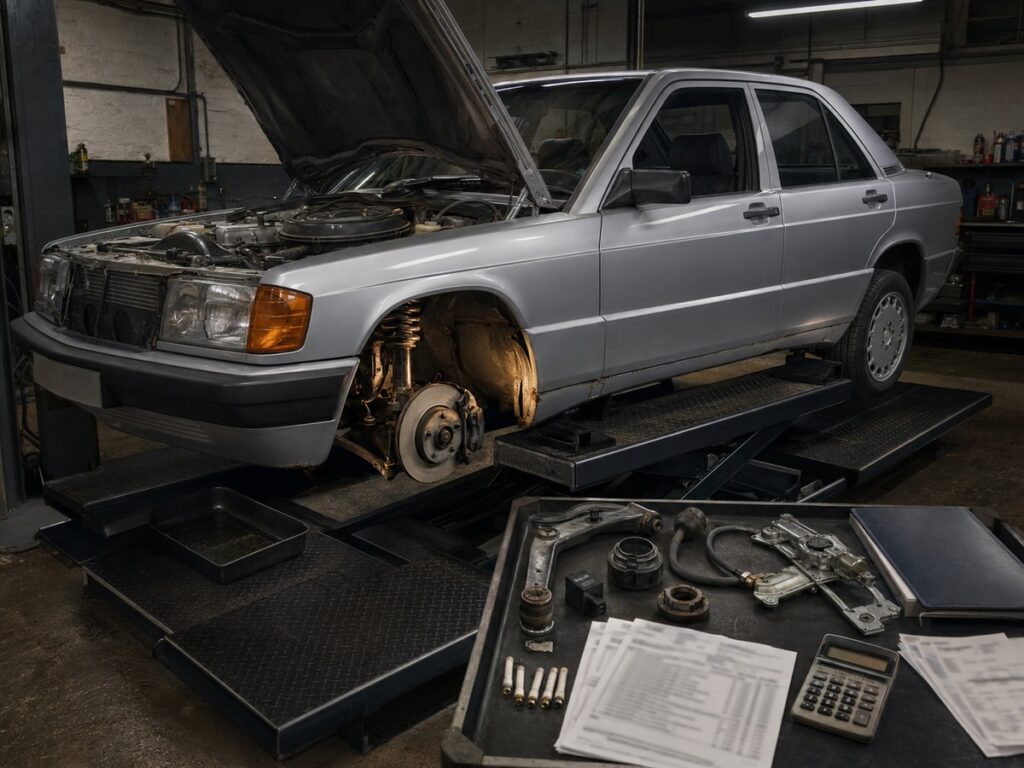
The 190E’s common problems rank in a short list: rust at six known body locations, the OVP relay’s rough-idle symptoms, perished vacuum lines, the M103’s head gasket above 250,000 km, broken odometer gears, the heater monovalve, and tired suspension bushes. None is mysterious, all have known costs, and the worst body repairs outprice the worst mechanical ones.
The problem list, ranked by frequency
Thirty-five years of community records rank the faults clearly. Costs are 2026 UK figures, specialist labour, with the DIY parts price where the job suits a home spanner.
| # | Problem | Affects | Symptoms | Fix cost |
|---|---|---|---|---|
| 1 | Rust at the six known locations | All | See the corrosion map | £250 – £2,500 per location |
| 2 | OVP relay | All petrol | Rough idle, stalling, ABS light | £40 – £80 |
| 3 | Perished vacuum lines | All | Lumpy idle, poor auto shifts | £40 DIY |
| 4 | Worn suspension bushes | All | Rear clonks, vague steering | £600 – £900 done |
| 5 | Odometer gear failure | All | Mileage stops counting | £30 DIY, £150 done |
| 6 | Heater monovalve | All | No heat, or heat stuck on | £60 – £120 |
| 7 | M103 head gasket | 190E 2.6 | Oil in coolant, misfire on 5/6 | £600 – £900 |
| 8 | Timing chain tensioner | All petrol | Cold-start rattle | £700 – £950 with chain |
| 9 | Window regulators | All | Slow or stopped glass | £80 – £180 per door |
| 10 | Self-levelling spheres | Code 489 cars | Harsh rear ride, slow recovery | £150 per sphere |
| 11 | Fuel pump relay | All petrol | No start, intermittent | £25 – £60 |
| 12 | Tank sender / fuel gauge | All | Erratic needle | £40 – £90 |
The pattern worth noticing: ten of the twelve cost under £1,000 to put right, and the two that can exceed it (rust and the chain job) announce themselves early to anyone who inspects. The buyer’s guide turns this list into a viewing sequence.
Which problems kill 190Es?
Rust, and almost nothing else. The mechanical faults on this list inconvenience owners; the body faults total cars. Structural corrosion at the rear subframe mounts or front strut towers exceeds repair economics on every eight-valve W201, which is why the corrosion map grades those two locations as walk-away items and everything mechanical as negotiation.
The engines themselves rank among the most durable of their era. The reliability reference documents the ceiling: 500,000 km diesels, 350,000 km M102 petrols, with the M103’s head gasket as the range’s one genuine mechanical reputation. Treat the gasket as a scheduled cost on any 2.6 above 200,000 km without a receipt for it, price it at £600 to £900, and the six-cylinder car stops being a gamble.
What fails on the 16-valve cars specifically?
The Cosworths add four items to the standard list, all maintenance-shaped:
Cam follower wear from stretched oil intervals: top-end clatter under load, £900 to £1,400 with the head off. The 6,000 km oil habit prevents it. Skipped valve adjustments: the 30,000 km job that decides whether a 16v runs like its reputation or its price. £350 to £500 at a specialist. KE-Jetronic components at rebuild age: warm-up regulator and fuel distributor, £350 to £500 each as rebuilt exchange units. Second-gear synchro in the dog-leg Getrag: a cold crunch, endemic at high mileage, £600 to £900 to rebuild. The transmission guide covers how to test for it in a car park.
None disqualifies a car. All four belong in the price.
The small irritations every owner meets
Below the headline faults sits the £100-and-under tier that defines week-to-week ownership. The odometer gear strips and the mileage freezes; a £30 gear and a careful evening behind the cluster fix it, and the buyer’s guide explains why a frozen odometer demands inspection-record cross-checks when buying. The monovalve sticks and the heater quits; the part crosses from the W123 and W126 per the interchange register. Ceramic fuses oxidise and motors slow down; a £10 fuse set cures it. Window regulators tire; the door cards come off with eight fasteners. The W201 fails politely, in components, with parts at sensible prices.
Which problems belong to which variant?
The master list above applies range-wide; each variant adds its own appendix.
190E 2.0 and 2.3 (M102 8v): the cleanest sheet in the range. Pre-1988 cars add the mechanical-lifter valve check; carburettor-era 190s add carb tuning to the list. Otherwise the master list is the whole list.
190E 2.6 (M103): the head gasket, plus a thirstier appetite for engine mounts (the six’s torque works them harder) and the cooling-system vigilance the gasket demands.
Cosworth 16v: the four specialist items covered above, plus self-levelling spheres as standard fitment and the KE-Jetronic components ageing into rebuild territory on unrestored cars.
190D diesels: glow plugs, injection pump seals weeping with age, and vacuum pump wear (the diesel’s brakes and locking depend on it). The engines themselves contribute nothing else to this page, which is their entire reputation.
Late cars (1991 on): the newest W201 is now decades old, and the last-of-line cars add nothing specific beyond the youngest examples of every item above.
The pre-purchase hour: mapping the twelve to checks
Every fault on the master list announces itself to a buyer who knows where to look, and the full method lives in the buyer’s guide. The compressed version, mapped to this page:
- Rust (problem 1): twenty minutes underneath with the inspection sheet. This hour’s main event.
- OVP, vacuum, fuel relay (2, 3, 11): cold start behaviour, idle quality, and whether the ABS light keeps the engine company.
- Bushes (4): rear clonks over the test-route’s worst surface; steering slack at parking speeds.
- Odometer (5): does it count? Cross-check inspection records either way.
- Monovalve (6): does the heater respond? Thirty seconds on any test drive.
- M103 gasket (7): coolant colour, oil filler underside, misfire from cold on five and six.
- Chain tensioner (8): the first five seconds of a cold start, ears open.
- Regulators, spheres, sender (9, 10, 12): windows up and down, rear ride quality over speed bumps, fuel needle stability.
A car that passes all eight sweeps carries no surprises from this page. Whatever it failed, the costs above convert directly into negotiation.
What does a problem-free 190E cost to keep that way?
Prevention prices lower than every repair it prevents. The full schedule lives in the maintenance guide; the problem-specific version compresses to five habits:
- Cavity wax every three to four years (£100 in materials): removes the only fault on this page that totals cars.
- Oil on schedule: protects the chain, the tensioner, and on 16v cars the followers.
- Coolant every three years plus an annual pressure test: the M103 gasket’s best defence.
- A £150 relay-and-vacuum refresh once: deletes problems 2, 3 and 11 for a decade.
- Exercise: monthly full-temperature drives keep seals, injection and brakes out of the failure statistics that sitting writes.
An owner running those five habits meets this article’s list as trivia rather than invoices.
How does the 190E’s problem list compare with rivals?
Shorter and cheaper. The E30 comparison covers the headline rival: the BMW adds timing-belt discipline, camshaft wear on the M40, and a longer rust map at higher parts prices. The W124, the W201’s bigger brother, shares most of this page’s list plus its own wiring and biodegradable-loom era risks on later cars. Against 1980s rivals from outside Germany, the comparison stops being close enough to tabulate.
The honest weakness in the W201’s record is age itself: every rubber part, hose and bush on an unrestored car is past design life, and the rubber-refresh year the maintenance schedule recommends is the price of entry to the reliability the model is famous for.
Three worked cases: what neglect multiplies
The £40 fault that became £400. A wandering idle ignored for a year invites the parts cannon: new idle valve, new plugs, a carb-style “tune,” then finally the OVP relay that caused it. The diagnosis order run on day one costs one relay.
The £900 job that became £2,400. An M103 weeping coolant for two summers cooks its head gasket into the head itself: machining, a skim past limits, and a donor head from the interchange register join the bill. The annual £15 pressure test exists for this case.
The £100 location that became a parts car. Surface bubbling at a jacking point, undersealed over instead of repaired, met an MOT tester’s screwdriver three years later as structural sill rot at all four corners. The corrosion map’s severity ladder is a schedule of compounding interest, and cavity wax is the only payment that stops it.
The list at the top of this page prices faults caught at first symptom. Multiply by three for faults caught at second symptom, and by the value of the car for faults caught by an inspector.
Frequently asked questions
Are Mercedes 190Es reliable? By classic standards, exceptionally. The faults list is short, known, and mostly under £1,000. Rust is the one threat that totals cars.
What is the most common 190E problem? Rust at the six documented locations, then the OVP relay’s rough-running symptoms on petrol cars.
Why does my 190E idle badly? OVP relay, vacuum leaks, then the idle control valve, in that order of cost. The electrical guide walks the sequence.
Is the 190E 2.6 head gasket common? Above 250,000 km, common enough to price in: £600 to £900. Documented coolant changes delay it; a receipt for the job done removes it.
Why has my odometer stopped? The plastic odometer gear, a known failure. £30 in parts. Cross-check past inspection records for the true mileage before selling or buying.
Do all 190Es have rust problems? All unrestored cars have rust somewhere; the question is which of the six locations and how deep. Twenty minutes with the rust inspection sheet answers it.
What’s the most expensive 190E repair? Structural rust repair, at £900 to £2,500 per location. The costliest common mechanical job is the timing chain service near £950.
Which 190E has the fewest problems? The 190D diesels, whose engines outlast the bodywork, and the post-1988 M102 2.0 with hydraulic lifters and the simplest specification.
How many of these problems stop the car? Two: the fuel pump relay and, indirectly, a chain tensioner ignored to failure. Everything else degrades the car without stranding it, which is the range’s quiet superpower.
Are 190E problems expensive compared with other classics? Cheaper than nearly anything comparable. The shared Mercedes parts bin keeps ten of the twelve faults under £1,000 fixed, and most under £200.
Should a known problem stop me buying? Only structural rust. Every mechanical item on this list converts to a price reduction using the figures above; the buyer’s guide shows the negotiation sequence.
What’s the rarest failure on the list? Strut tower rust, and it matters because it is also the most serious. Check it in thirty seconds at every viewing regardless of the odds.
Take this with you
Got a 190?
Submit your build and we'll feature it across our YouTube, TikTok and Instagram channels.
Start your garage →